

The common cellular phone has always been a terrestrial communications device, speaking to towers dotted about the landscape. Meanwhile, satellite phones have long existed as specialized equipment, for staying in touch far beyond the coverage areas of the cellular network. They’re expensive to use, with dedicated antennas and radio chipsets for talking to dedicated constellations of satellites flying overhead.
These days, though, the lines are blurred. You can have a regular old smartphone that has two-way satellite communications capabilities baked right in from the factory. This new technology has only been around for a few years, but it’s already changing the game when it comes to staying connected when trekking out far from civilization. But how does it all work?
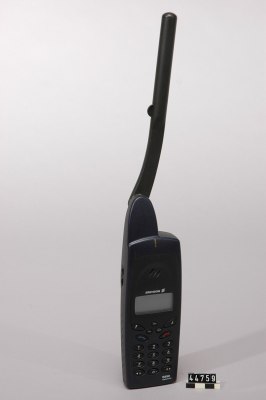
There’s a reason phones haven’t historically communicated with satellites, and have relied on terrestrial cells instead. The latter have ranges measured in the tens of kilometers, maybe extending out to 50 kilometers with clear line of site in ideal conditions. Today’s cell phones are typically capped at a transmit power of just 0.2 W. Modern antenna designs in phones and on cell towers are good enough to allow reliable communication over these distances at such a power level. As a guide, for a cell tower sitting 2 km from a cellphone, a link budget might sit around 104 dB.
However, satellites are much farther away, which makes things much harder. If the satellite is in low earth orbit, say, 360 km away, that link budget is more like 149 dB. That’s much worse—in clearer terms, the satellite is receiving 32,000 times less power than the cell tower. Step out to the 35,786 km orbit of a geostationary satellite, and you’re looking at a link budget of 188 dB. At those greater distances, there’s so much less signal power arriving on target.
Regulatory compliance means that smartphone manufacturers can’t simply jack up the transmit power to better reach distant satellites. Instead, a multitude of tricks are brought to bear to make communication possible. Slower data rates increase signal to noise ratios, while in some cases, users are asked to point their phones at satellites to take advantage of antenna directionality to improve the link. Devices must also calculate for factors like propagation delay and Doppler shift, thanks to the distance and speeds involved, and adjust their transmissions to suit, as well. With the right combination of techniques, though, it’s possible to build a smartphone with enough link budget to get short messages to and from satellites that are orbiting beyond the atmosphere.
Satellite comms are not yet a ubiquitous feature available on every phone on the market, but the number of satellite-capable phones is slowly proliferating over time. Whether you’re an Apple or an Android user, there are a variety of ways you can access satellite communications from your modern smartphone. How you make a connection depends on your particular phone, and sometimes, your carrier. Different systems also have different levels of functionality, too, and different requirements for the end user.
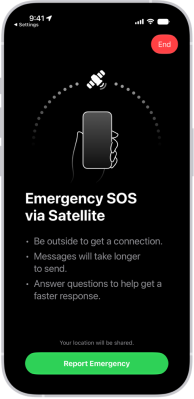
Apple’s foray into smartphone satellite communications started with the iPhone 14. The feature was first launched as the “Emergency SOS” service, wherein users could send emergency messages via the Globalstar satellite network using a proprietary protocol, communicating with the then—25 satellite constellation over L-band and S-band.
The system operates on the “bent-pipe” concept, where the satellite receives a signal and then retransmits it down to a station on the ground. Emergency messages picked up by ground stations are thenrouted to the relevant authorities. In the years since launch, though, Apple has opened up the functionality of the system, allowing users to send and receive non-emergency text messages via SMS and iMessage and send location data via the Find My service with certain conditions, as well as request roadside assistance.
Connecting to a satellite requires being outside with a good view of the sky, ideally without obstructions that could block the signal, like buildings, trees, or hills and mountains. When connecting via satellite, the iPhone provides guidance to the user on how to best aim the phone to make a strong connection. Notably, the data rate of the system is quite limited, due in part to Globalstar’s satellite network orbiting at a high altitude of 1414 km. For this reason, Apple implemented compression techniques for text messages sent over the system to make the most of the limited bandwidth on offer.
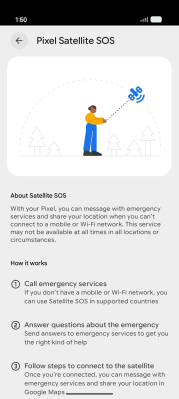
In the Android world, satellite connectivity first became a thing with the 3GPP Release 17 NB-NTN standard for narrowband non-terrestrial communications, similarly in S-band and L-band. Rather than jumping on a single existing satellite network like Apple, instead, the Android world ended up working with Skylo. The company does not own any satellites of its own; instead, it operates various NB-NTN ground stations around the world, while leasing communications capacity on existing satellites from companies like Viasat, Ligado Networks, Echostar, and Terrestar Solutions, with the same bent-pipe concept that Apple uses, effectively. The available satellites comprise those in both low-earth orbit and geostationary orbits, with the latter being far enough to really strain link budgets to the limit.
Similarly to Apple’s solution, the tech first hit the market with the Pixel 9 in 2024, as an emergency tool called Satellite SOS, with messages bouncing down to Garmin’s emergency coordination centre. The Pixel 10 added satellite location sharing. Samsung then joined the fray, with the S25 series, Z Fold 7, and S Flip 7 later allowing text-only SMS-style messaging for users signed up with Verizon. Availability of various emergency and non-emergency messaging services on Android remains scattered, dependent on handset manufacturer and mobile carrier.
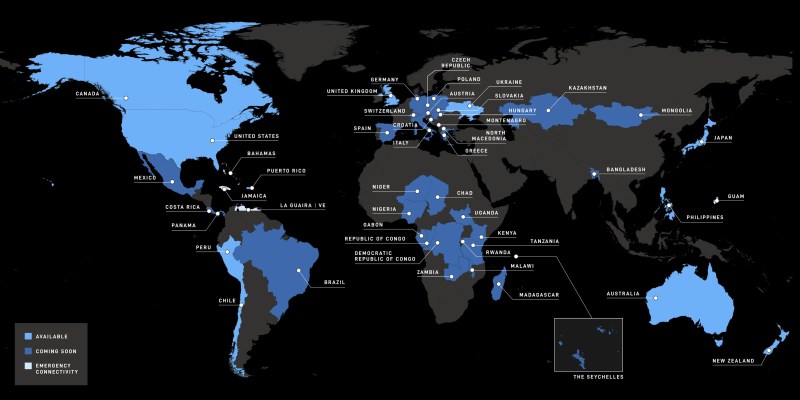
There is another, entirely different concept for satellite communications for modern smartphones. That is—what if a satellite was just a cell tower, that a phone could talk to using its regular modem like any other? Rather than a bent pipe, redirecting messages to ground stations, the satellite instead flies its own cellular hardware, communicating directly with the cellular device below. The Starlink constellation offers exactly this, with its direct-to-cell (D2C) satellites flying eNodeB cell tower hardware in orbits from 330 to 370 km. Backhaul then travels via the Starlink laser network and eventually back down to ground stations, where the traffic hits a cell carrier’s network as if it came in over roaming.
The technique requires some trickery on the part of the satellite—namely, the cell hardware on board has to do a bunch of frequency shifting to cancel out the Doppler effect from travelling at 7.5 km/s, while also accounting for the propagation delay due to the long distances involved. Notably, the system operates on existing cellular spectrum, since it’s acting as a regular old cell tower, just one that’s very high up and moving very fast relative to the ground. The satellites also have large 6 square-meter antennas, much bigger than earlier Starlink satellites, to maximise the signal picked up from regular LTE phones communicating with just 0.2 W.
Since the satellites are flying LTE hardware, a wide range of regular smartphones can connect, all the way back to certain handsets from 2021. However, it’s not available on just any modern phone; there are still limited lists of compatible handsets that will work. By virtue of the low altitude of such satellites, data rates aren’t too shabby—on the order of 7 megabits/sec in good conditions. Carriers that offer direct-to-cell service via Starlink allow sending and receiving text messages, location sharing, as well as using select apps like Apple Maps, Google Maps, WhatsApp, Messenger, and Signal. For now, though, heavy streaming data and voice calls are not supported due to the performance limitations of the service.
Competing companies are aiming to get into the flying cell tower market, too. Satellites with larger arrays, like the AST SpaceMobile BlueBird 6, are entering operation with antennas measuring a massive 223 square meters, for even better performance. The concept remains the same—fly cellular towers, account for the unique issues with putting them in space, and let otherwise regular phones communicate outside of regular terrestrial cell coverage.
Overall, satellite connectivity is somewhat unique to the smartphone world because of its lack of standardization. Cellular communications have traditionally been highly standardized across manufacturers and cell networks. When it comes to satellite, though, it’s become an area of competition between both those making the handsets and those running the networks. In the future, satellite connectivity may become more normalized, and we’ll all be connecting to the odd satellite cell when we’re out in the boondocks. For now, though, you have to navigate the peculiariaties of different satellite networks and their feature sets and availabilities if you want to use your smartphone with space-based communications links. Expect it to remain complicated for some time to come.


